A music teacher's toolkit, inside your AI assistant

Music Tutor lets Claude and ChatGPT put real music in the chat: notation you can hear, chords on piano or guitar, harmony examples from the classics, graded sight-reading and listening games.

ClaudeChatGPT
Try
Show me a real Neapolitan sixth
Music Tutor · Real harmony
FreeNo accountPublic-domain musicPiano and guitarWorks in Claude and ChatGPT
What it does

Music you can see, hear and play along to

Instead of describing music in words, your assistant shows it on a staff, plays it with a real piano sound, and points at the keys or frets. Every card has play, pause, tempo and click-a-note to jump.

Real harmony, from real pieces

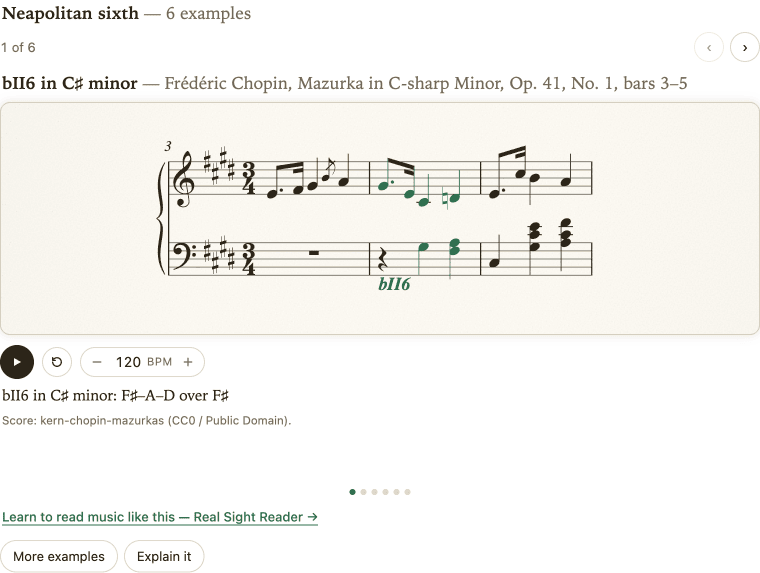
Studying a Neapolitan sixth, a German sixth or a deceptive cadence? See it in Chopin, Mozart or Schubert: the passage engraved, the chord coloured and labelled, then played. Swipe for more examples, or ask to see the whole piece.

Show me a real Neapolitan sixthA deceptive cadence in MozartShow me more of that piece
A Neapolitan sixth in Chopin's Mazurka Op. 41 No. 1, the chord's notes in green and labelled bII6, first of six examples

Any chord or scale, spelled right

The exact notes on a staff and a keyboard, with the guitar shape underneath. Chords play together then broken; scales run up an octave. Cb major really is Cb–Eb–Gb.

What notes are in F#m7?How do I play Gmaj7 on guitar?Show me D harmonic minor
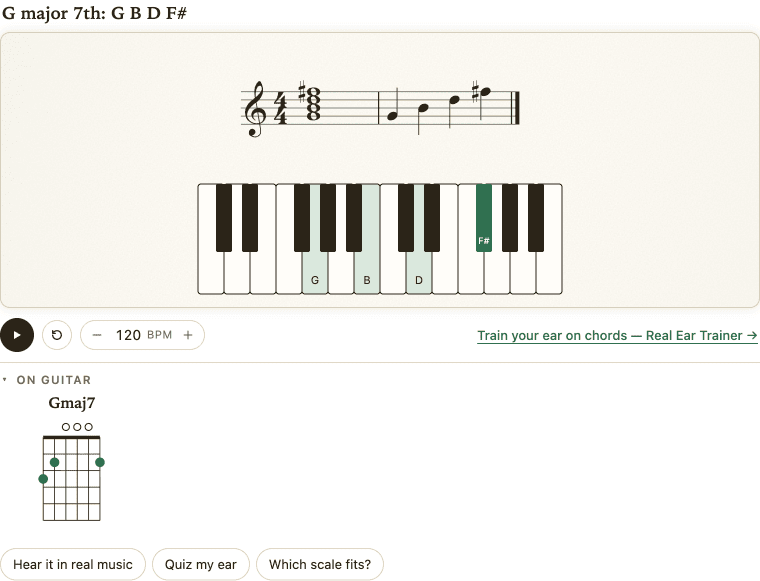
G major 7th: the chord on a staff, the keys G, B, D and F sharp lit on a keyboard, and the Gmaj7 guitar chord box

Sight-reading from real music

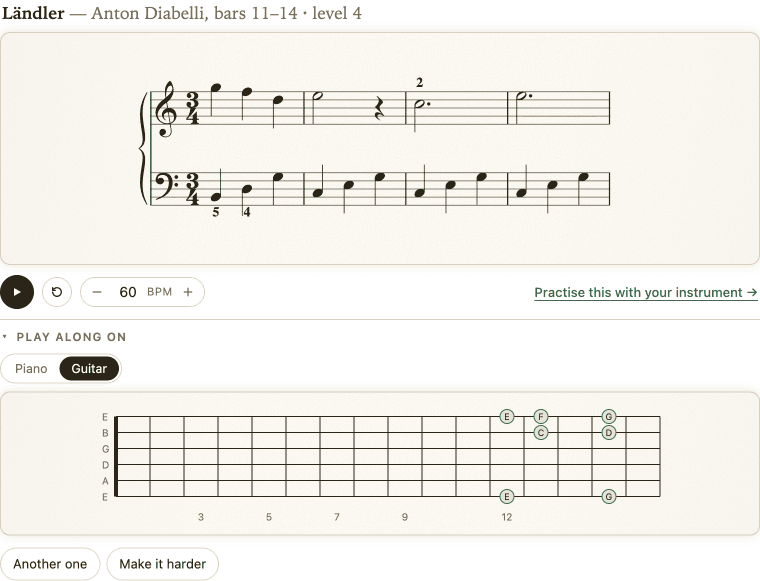
Short passages from public-domain piano works, graded from level 1 to 10, or focused on one skill like ledger lines or dotted rhythms. Open Play along on to follow the melody on a keyboard or a guitar fretboard as it plays.

Give me a level 4 sight-reading exerciseI struggle with ledger linesMake it harder
A four-bar Diabelli Ländler at level 4 on a grand staff, with the melody laid out on a guitar fretboard underneath

Guess the composer

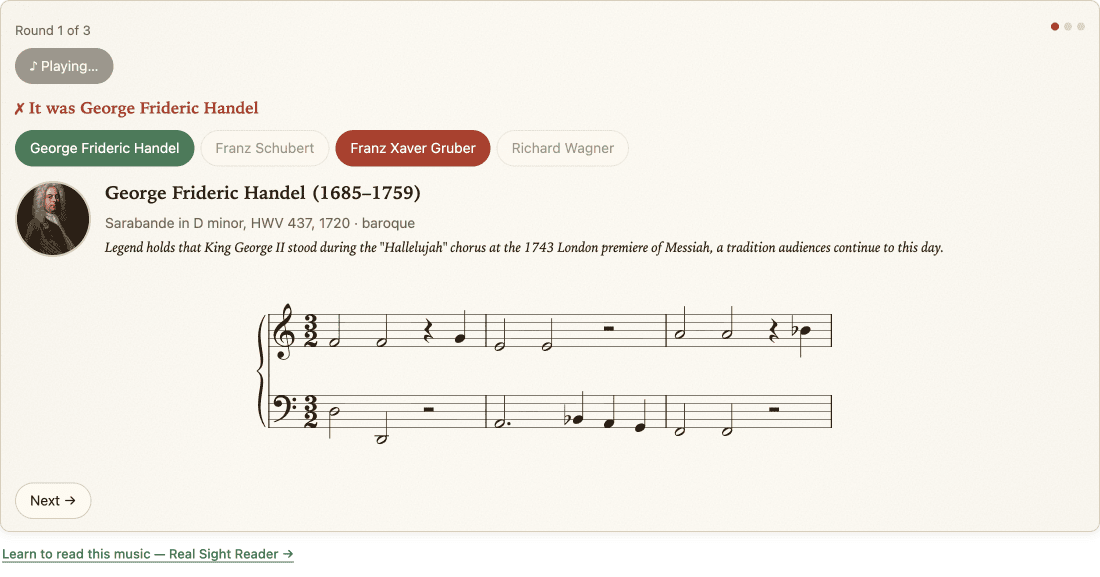
Hear a famous opening, pick the composer from four. Each answer reveals the portrait, dates, a story and the notation. Play the daily puzzle and share your score.

Let's play guess the composerToday's daily composer puzzle
Guess the composer, round 1: the answer was Handel, revealed with his portrait, dates, a fun fact and the notation of his Sarabande in D minor

Ear training with feedback

Intervals, chord qualities, inversions, scales and modes — exactly the contrasts you want to drill, played the way you choose. At the end you see what you mixed up, and the assistant suggests the next quiz.

Quiz me on intervals, easyP4 vs P5 vs tritone, harmonicDorian vs mixolydian
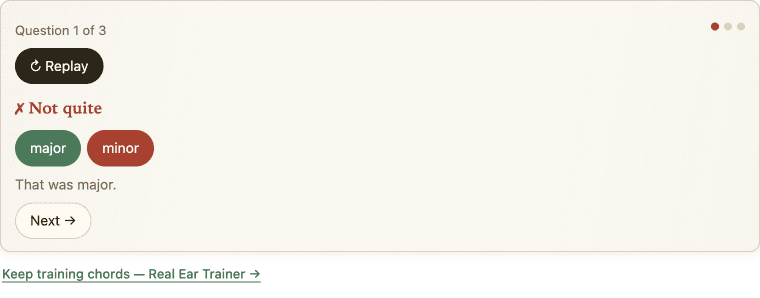
A chord quiz question answered correctly: minor, highlighted in green

And more

Find a piece

“How does the Moonlight Sonata start?” The real opening bars, playable. Or browse: famous openings by Chopin, by era, by form.

What to learn next

“I can play Für Elise — what next?” Pieces from Music Tutor's level 1–10 learning path, each with its opening to hear and what it will teach you.

Lead sheets

Carols, hymns and folk songs with melody, words and chord symbols; chords sound under the tune and light up as they play.

Transpose for your instrument

“For my clarinet”, “for alto sax”, “lower it for my voice”. Written for your instrument, played back at concert pitch.

Notation for anything

Any scale, progression or melody the assistant explains, engraved on a staff or grand staff with playback.

Piano or guitar

Chord diagrams and the play-along panel switch between keyboard and guitar. Your choice is remembered.

Practise with your instrument

Cards link to the same music on Real Sight Reader and Real Ear Trainer, which listen to you play.

Add it

Two minutes to set up

Music Tutor is an MCP server. Paste one URL into your assistant and it gains the tools.

https://musictutor.app/mcp

Claude

  1. Open Settings → Connectors → Add custom connector.
  2. Name it Music Tutor, paste the URL, leave sign-in fields blank, and Add.
  3. In a chat, enable it from the tools menu and ask away.

ChatGPT

  1. Turn on Developer mode under Settings → Apps & Connectors → Advanced.
  2. Choose Create, name it Music Tutor, paste the URL, pick No authentication.
  3. In a new chat, attach it via + → More and ask away.

Claude Code

claude mcp add --transport http music-tutor https://musictutor.app/mcp

Any other MCP client: point it at the URL. No sign-in.

Try asking

Chords for Silent Night How do I play Bbmaj7 on guitar? Show me a real German augmented sixth Give me a level 3 Bach passage to sight-read Show me the Moonlight Sonata for alto sax Famous romantic openings Let's play guess the composer Quiz me on intervals, easy
FAQ

Good to know

Does it cost anything?

No. There is no account, no sign-in and nothing to pay.

Where does the music come from?

Public-domain works only: composers who died 70+ years ago, pieces published before 1930, or traditional songs. Harmony examples come from open research corpora and show their source and licence. Think something is not public domain? Tell us.

What do you collect?

Only the tool inputs your assistant sends, like a level, a chord name or notation to engrave. Never your conversation. This website counts visits with PostHog. Cards send anonymous practice-action counts, without answers or scores. Privacy.

Can I practise with my own instrument?

Yes. Follow along on piano or guitar in the card, or open the free practice pages of Real Sight Reader and Real Ear Trainer, which listen to you play.